Public Private Space (2024)
- Yolanda Ren
- Dec 1, 2024
- 7 min read
Interactive Installation
June 22, 2024 - July 1, 2024
This blog provides a comprehensive record of the processes, designs, components and analysis of this artwork. It consists of four parts: 1. the artist's statement, 2. the initial setup and materiality, 3. a record of viewers' interactions during the one-week exhibition, 4. an analysis of the artwork's significance, and 5. a set of photo documentation of the space by the end of the exhibition period.
Given its nature as a time-based interactive installation with multiple elements, its documentation includes detailed information essential for readers to fully grasp its essence.


1. Artist's Statement
The artwork unfolds within an intimate enclave, its boundaries wrapped in a shimmering, blurred reflection of mylar or polyester film. A projector and computer stand sentinel, inviting a shared yet deeply personal experience. This sanctuary aims to dissolve alienation, fostering a sense of interconnectedness. Within this limitless realm, visitors are free to reflect, dream, contribute their thoughts to the installation, reach out to the external world, or read the musings of others.
The reflective mylar symbolizes "the subject": the individual, the "I" who steps into this space. The setup draws a clear boundary between a created triangular-shaped world and the outside world, with the latter's content gathered and represented by the laptop. The external world always reaches out to the subject, with communication symbolized by the projection.
This artwork begins as a deeply personal refuge, akin to a secret hideaway from childhood, yet it resides in a public gallery to be the crystallization of shared experiences and sometimes memories. As more visitors pass through, leaving their graffiti and phrases on the reflective surface, the space evolves into a tapestry of histories, inheritance, and playful interactions—a message board chronicling the contemplations of those who have visited before. It suggests that personal experiences and histories are interwoven, creating a rich tapestry of collective memory. This can be seen as a critique of individualism, promoting a more interconnected, communal approach to understanding identity and history.
By this design, I intend to push the boundaries of interactivity and explore the dynamic and temporal nature of a time-based installation to an experimental extent. Placing this installation in a white-cube gallery setting challenges the traditional view of art as a permanent, unchanging object and instead presents it as a living entity that grows and transforms with its audience.


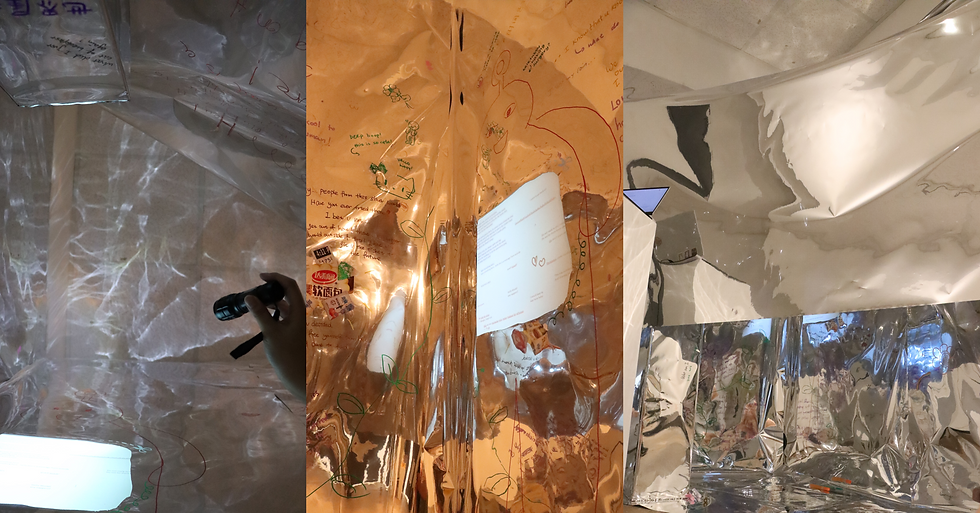
2. Materiality and The Initial Setup

The artwork began as a triangular-shaped mylar space tucked into a corner, intentionally crafted with only a small opening that requires individuals to bend down to enter. This deliberate design fosters a sense of entering a private, secret sanctuary, while the compact size of the space suggests it is intended for one person to enter at a time.
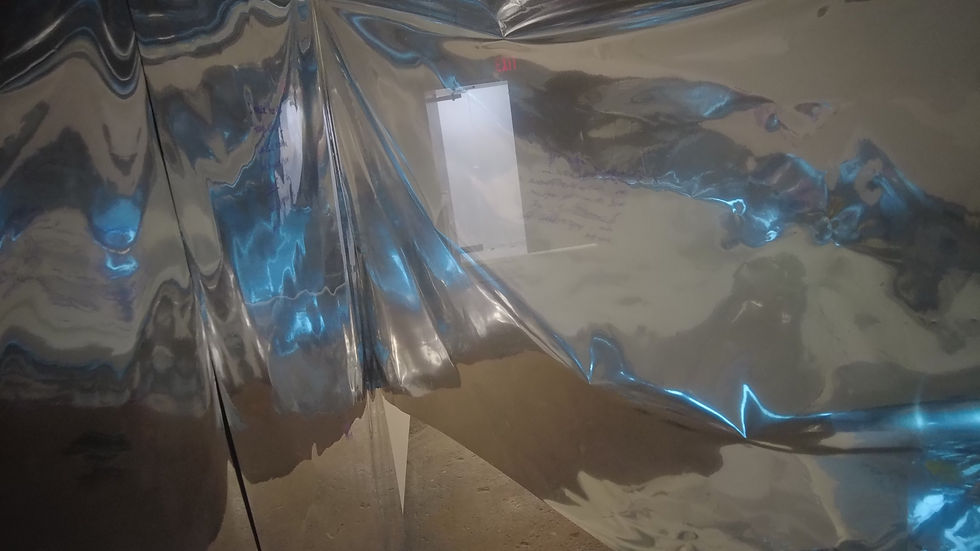
The mylar material is inherently connected to the concept of reflection, and wrapping it around the viewer upon entrance to the space speaks the language of "self-reflection". Moreover, because the space is generally dimmer and smaller inside compared to the outside, the material allows those inside to see the outside gallery space but not vice versa. This connection imbues the space with the concept of a "safe space".

The projector projects light and content to a window-like space that's carved out of mylar, and is connected to the computer on a white cube outside the mylar space. With a text pad opened with a poem and "type something here…", the computer invites other viewers outside the structure to communicate with the viewer inside.
(This display patch eventually transfer to something like this by the end of the exhibition time:)


Other than the projection, the space has prompts written on the mylar material that are some thoughts of mine at the moment when I'm alone, and the markers scattered on the floor invite the viewers to write down their thoughts or draw random marks while one spends time in the space. They invite viewers to contemplate the complexities of human existence, the nature of communication, and the interplay between self and society.

Here are the prompts:
“Who am I, really?”
“I want to go to Hawaii. I want to go paragliding.
A rainbow and a “;)”
“You describe it to me and you teach me to classify it. You enumerate its laws and in my thirst for knowledge I admit that they are true. You take apart its mechanism and my hope increases. At the final stage you teach me that this wonderous and multicolored universe can be reduced to the atom and that the atom itself can be reduced to the electron. “
“All this is good and I wait for you to continue. But you tell me of an invisible planetary system in which electrons gravitate around a nucleus. You explain this world to me with an image. I realize then that you have been reduced to poetry: I shall never know.”
“One must imagine Sisyphus happy.”
“I’m gonna have a good meal later” in Simplified Chinese.
“How long will I live? In what way will I die?”
The outline of my left hand

The projector and the white cube inside the mylar space are both wrapped in mylar as well in order to imply that it’s not the point of focal point but rather part of the continuous space that serves the viewer as a tool. In this way, the artwork transcended its physical boundaries, becoming a collaborative canvas for collective expression and exploration.
The flashlight reflects and refracts light in various directions as the viewer picks it up and moves it around, creating beautiful, dynamic and abstract patterns on the ceiling. The room's light is adjusted to a dim level where the text is barely readable, pushing the viewers to pick up the flashlight.


Here is how the space looks like before any viewer sees it:

3. A Incomplete Record of the Viewer's Interactions and Reflections
** A text record of everything that the viewers wrote/doodled are attached to the end of this blog.

The first viewer: it feels like being in a sci-fi setting, communicating with creatures from another world, because the material is inherently sci-fi.
The second viewer: it feels like another world, which I call "the silver world". I imagine a host of creatures locked inside, longing to come out and explore the world (she cut out items she was with and sticked them to the mylar wall: movie tickets,


Starbucks labels, TTC tickets, snack bags, etc.) Emotionally, it also resembles the comfort space I used to create as a child using pillows.
3th: It feels like a safe space, where I feel secure, similar to the comment boards found in exhibitions and galleries, where visitors leave their thoughts after experiencing the exhibits. This inspired me to write down my own thoughts and feelings. I wrote some poem lines because they match what I feel about this project, as it will
eventually be taken down one days so are the thoughts written here.
(She also wrote her favorite poem lines: “you are not others. -- Borges, Jorge Luis” (in the laptop) and “Your matter is time, ceaseless time. You are each solitary moment.” (in the mylar space) both in Spanish.
The previous line was responded later by the 6th viewer by: “stop reading nonsense, my boy, better bring some sodas. – your uncle” in Spanish also.)
4th: I reflected on myself a bit in the space (drew myself), and simply wrote down what I was thinking at the moment.
5th: the other world; a space where one can write anything.
6th and 7th: a place of alienation.

8th: like a comment board.
9th: and 10th: It feels like a private reflective space at first. As we stand up and see more of the phrases on the wall, it feels like the outside world enters this space, and we are communicating with the world in a positive way, as the content is warm-hearted.
11th, A group of people: Twitchat. Reminding me of childhood. A communal reflection space.
A video record of the installation by the end of the exhibition period: https://youtu.be/3oGHQ1duyJs


4. Further Analysis
One unique aspect of this artwork is about how unlike typical artworks, where each viewer often has a similar experience, this piece transforms with each visitor's interaction, creating a unique journey from the first person to the last. This transformation signifies the evolution of shared experiences and collective memory.
For most artworks, viewers share a consistent experience. In large and complex installations, the experience may vary depending on the viewer's approach, but the essence remains constant. Even interactive art often resets or cycles, offering each new viewer a fresh start.
This artwork, however, offers a distinct experience for everyone: in the first person encounter, the space unfolds as a wholly private realm, encouraging open imagination and personal interpretation. Here, the reflective material remains pristine, serving as a clear mirror for self-reflection. Indeed, viewers did come up with interesting interpretations such as locked aliens and "a silver world". Conversely, for the last person involved, the space transforms into a rich tapestry woven from accumulated histories, reminiscent of an inheritance. The reflective material becomes obscured by layers of text, drawings, and folds, shifting the focus from individual introspection to the collective narrative shaped by previous visitors.

This artwork then embodies the passage of time and the imprint of human interaction, highlighting the dynamic interplay between individuality and community. By this design, I intend to push both the interactivity between an artwork and its dynamic and temporal nature further to an experimental extent.

Additionally, by placing such an installation in a white-cube gallery setting, it challenges the traditional view of art as a permanent, unchanging object and instead presents it as a living entity that grows and transforms with its audience. What can art be by taking strong emphasis on the viewer's experience? What if an artwork's intention is for the viewer to understand the artwork as anything of their choices and thoughts? Can an artwork still have a coherent identity if its interpretation is entirely subjective? How does increased interactivity change the relationship between the artwork and the viewer, and does that make art a tool or service?


** A text record of everything that the viewers wrote/doodled


Comments